

On 15 October 1946, four women joined Iberia’s first commercial transatlantic service between Madrid and Buenos Aires, introducing a new profession to Spanish aviation.
Eighty years ago today, Pilar Mascías, Marichín Ruiz, María José Ugarte and Ana Marsans made Spanish aviation history. On 15 October 1946, they became the first women to serve as cabin crew members for Iberia, introducing a profession that would become an essential part of commercial air travel in Spain.

The four women worked aboard a Douglas DC-4 operating between Madrid and Buenos Aires. The journey took approximately 36 hours, including stops at Villa Cisneros, Natal and Rio de Janeiro.
For the 28 passengers on board, a one-way ticket cost 11,435 pesetas, equivalent to approximately €8,550 in today’s purchasing power. A return fare was 20,583 pesetas, or roughly €15,400 today.
The women had been selected primarily for their foreign-language skills, particularly English. Their duties included looking after passengers, providing reassurance during the long journey and serving meals.
According to Iberia, the food on that first flight was considerably simpler than today’s airline catering. Passengers received fried chicken, Spanish omelette, hard-boiled eggs and chocolates, packed in small cardboard boxes.
Spain’s first flight attendants
Even the name of the new profession was undecided in 1946.
Iberia considered several Spanish terms, including aeromozas, aeroviarias, mayordomas and provisorias. Eventually, azafata became the accepted term for a female flight attendant.
The profession was initially associated with women, but that changed quickly. In 1947, Fernando Castillo joined Iberia as its first male cabin crew member. He had previously worked as a waiter in a luxury Madrid restaurant.
The original four women had entered an occupation that was still taking shape, with passenger hospitality at its centre.
Eight decades of Iberia cabin crew uniforms
The first four flight attendants did not wear uniforms on their inaugural journey. Iberia introduced standardised clothing soon afterwards.
The earliest designs included white summer suits made from parachute fabric and navy-blue suits for the remainder of the year. The military-inspired appearance reflected the style of early commercial aviation.
White eventually disappeared from the collection because it stained too easily, while hats and other traditional accessories were gradually retired.
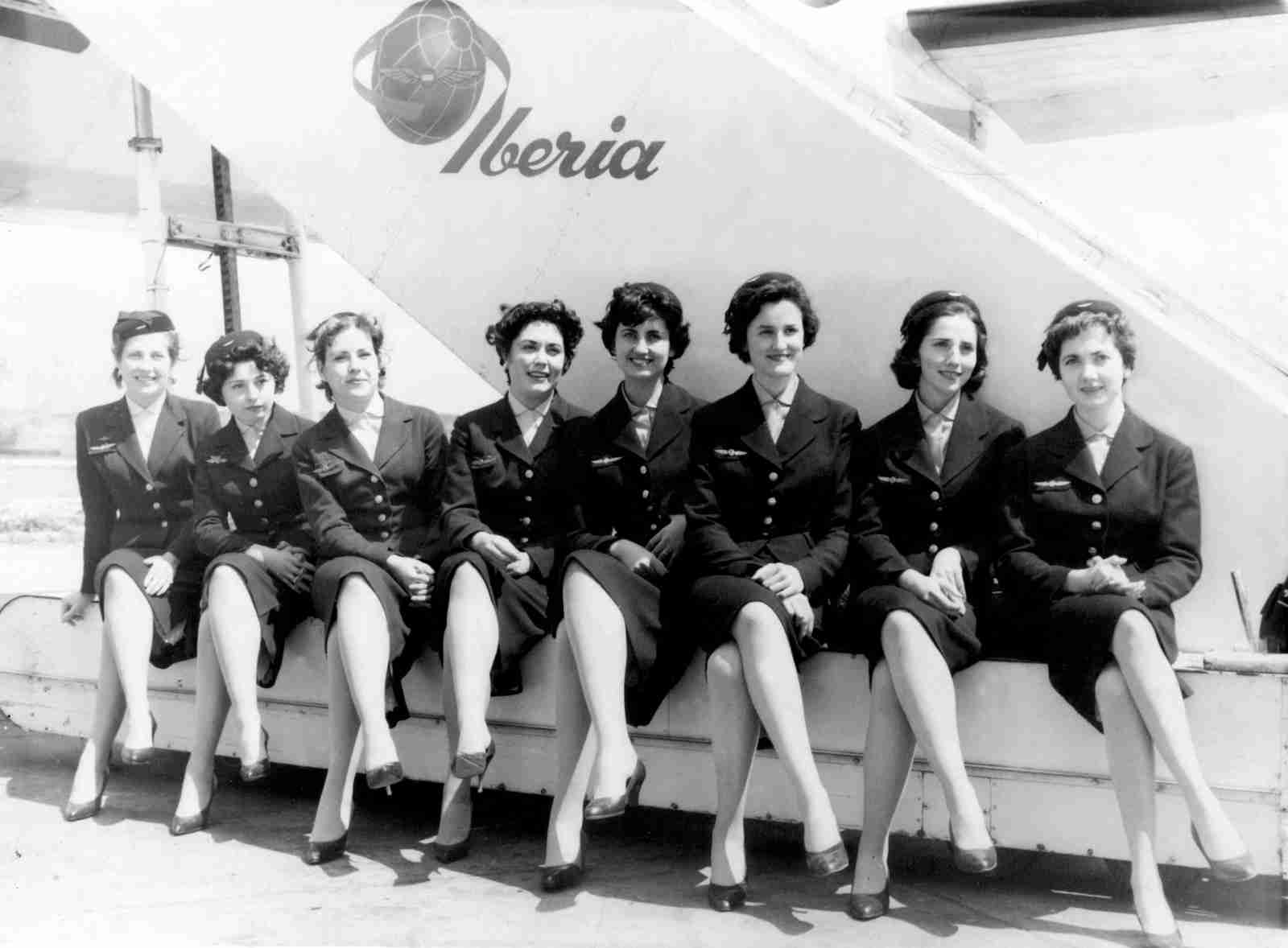
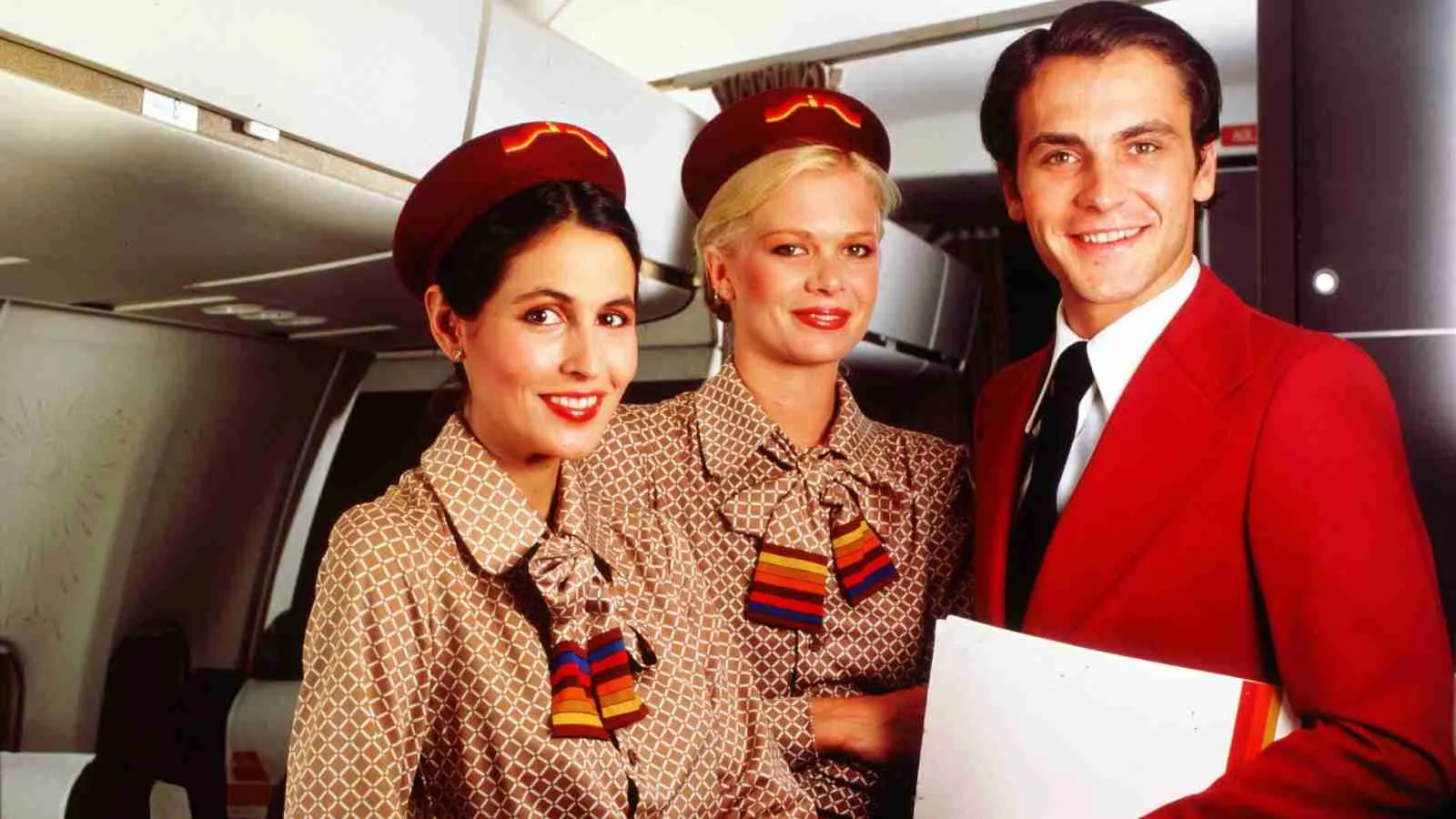
From the 1960s, Iberia developed a close relationship with Spanish fashion designers. Its uniform history includes designs by Pedro Rodríguez, Manuel Pertegaz, Elio Berhanyer, Alfredo Caral and Adolfo Domínguez.
In 2020, Teresa Helbig became the first woman commissioned to design Iberia’s crew uniforms. Her collection uses navy blue, red and yellow, combining the airline’s identity with clothing intended to be comfortable and practical for employees.

Iberia maintains an online archive of its historical uniforms, documenting the changing appearance of its cabin crew across the decades.
From passenger hospitality to aviation safety
The role of cabin crew has changed substantially since 1946.
Today’s flight attendants receive specialised training in emergency procedures, evacuation, first aid and the operation of safety equipment. Passenger service remains important, but safety is their primary responsibility.
“A cabin crew member does much more than deliver the safety demonstration. Among other duties, they are responsible for checking emergency equipment, managing evacuations, identifying behaviours that could compromise safety, and responding to unforeseen situations or medical emergencies. All of this is carried out in coordination with pilots and ground staff,” said Paco Rueda, Iberia’s Director of Cabin Crew.
Iberia currently employs 4,062 cabin crew members, including 2,735 women and 1,327 men.
From one flight every ten days to three daily departures
The first Madrid–Buenos Aires service operated once every ten days. Eight decades later, Iberia offers three daily flights between the cities, most operated by the Airbus A350.
The airline has identified Argentina as a priority market under its Flight Plan 2030 strategy.
Passengers can now make the transatlantic journey in a fraction of the time required in 1946. Yet the contribution of those four pioneering women remains part of Iberia’s history, and of the history of Spanish commercial aviation.


